Est. read time – 3-4 minutes.
Very sadly, Darcie died in August 2026. We continue to support her family.
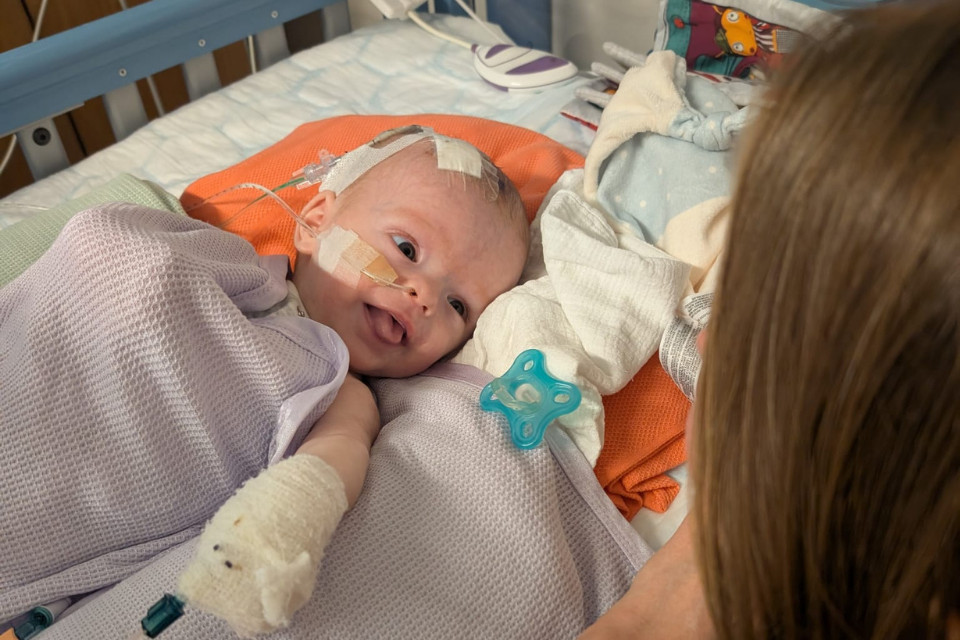
Darcie Game is a ‘bundle of joy’ with a strength and resilience that never ceases to amaze proud parents Ben and Alice.
The spirited ten-month-old has the rare, inherited genetic disorder Junctional Severe Epidermolysis Bullosa (Junctional EB). It makes her skin extremely fragile, causing multiple blisters and leaving painful scars – erosions – scattered across her tiny body. Darcie is one of only 5,000 people in the UK to have EB and has already exceeded expectations in terms of her prognosis. Ben and Alice were told their daughter may only live six months, but now her first birthday is looming in December.
“There have been times when her health has deteriorated and we’ve thought ‘this is it’,” said Alice, from Ipswich. “However, Darcie always seems to come out the other side, and she’s very strong and resilient. She’s doing well, in the circumstances, and is an absolute bundle of joy. She’s such a little character, and her personality shines through every day.
“No matter what life throws at her, she’s happy and content, and, without looking at her, you wouldn’t know there’s anything wrong. She’s amazing – a beautiful little girl that we both love so much.”
After a ‘perfect, normal pregnancy’, Darcie’s condition came to light just after she was born at home. It became obvious something was wrong because she had skin missing on both wrists and missing fingernails.
“Neither of the midwives had ever seen anything like it, and they thought it might be an infection I’d passed on to Darcie,” said Alice, 26. “We went from home to hospital and saw a couple of doctors who also didn’t have a clue what was wrong. At first, they thought she had Herpes, as that’s how it could present. We were given three lots of anti-biotics to try and clear up whatever it was, but nothing worked. Then, after three days, some blisters materialised on her neck and in her nappy area, which came as a shock.
“No-one, including consultants at the hospital, had any idea what the problem was, but then we were introduced to another lady who said she thought Darcie had EB. She’d seen another patient with the same condition – although that was more than ten years ago, which shows how rare it is.”
Darcie was referred to London’s Great Ormond Street Hospital – home to one of only two specialist teams in the country – and, within two days, a specialist visited the family at Ipswich Hospital. They did a biopsy and genetic testing, and then, six days later, Darcie was diagnosed with Junctional EB.
“Everything happened very quickly,” said Alice. “The blisters continued to appear all over her body and kept on coming – in her ears, on her belly and in the umbilical area. Another blister was on her neck. It went from the shape of a tic tac to spreading across her back, from shoulder to shoulder, in just two hours. Ben accidentally popped it with his finger when picking her up and the top of her back went red raw, staying that way for weeks. It looked so painful.”
Darcie’s blisters kept materialising, erupting across her tiny body, and that ‘incredibly hard and upsetting’ scenario continues to this day.
“You never think it’s going to be you, as everyone says, and it’s certainly taken some adjusting to,” said Alice. “Having not just a newborn baby in the house but a medically complex one has been extremely tough. It was particularly hard at the beginning, in terms of learning what we had to do to care for Darcie. Ben’s had to take a lot of time off work, and we’ve been shown what we must do when a new blister appears. They grow very quickly, so we have to pop them to stop them spreading or filling with more fluid. The area then has to be cleaned and covered and we put fresh bandages on every morning, which often need redressing in the evening. It’s relentless, and you never know what you’re going to see each day.
“We also have to be extremely careful at bathtime, using pads to clean her with a special solution.”
Darcie is prone to infections, and, as well as developing on the outside of her body, the blisters also form inside, in places like her mouth, oesophagus and gut.
It means her prognosis is bleak.
“Darcie’s specialist says the oldest she’s seen a child with her sub-type of the condition live to is six months,” said Alice. “It can vary, of course, like any illness, and children can live to the age of two. We just take each day as it comes, but we’re realistic about what the future holds. That said, she’s doing well at the moment and exceeding all expectations. It shows how strong she is, and she doesn’t ever seem scared by anything. It makes me determined to face my own fears and get on with things – just like Darcie.
“In terms of pain, Ben and I often say we’ll never moan or complain about anything ever again. It’s nothing compared to what she must go through and puts everything in perspective. She’s a very special little girl and a true inspiration.”
Published in October 2025